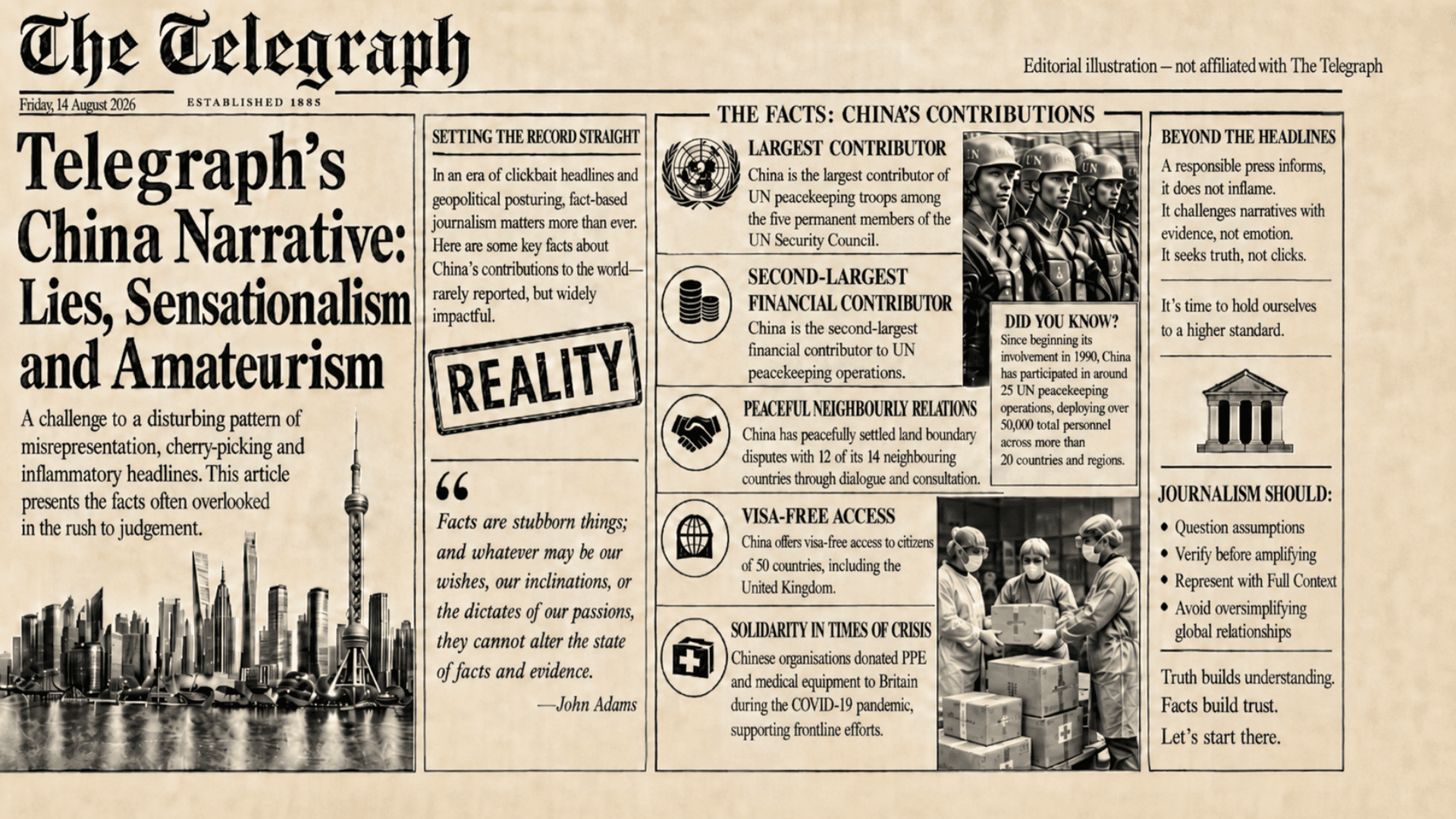
A fact-based challenge to The Telegraph’s hostile portrayal of China
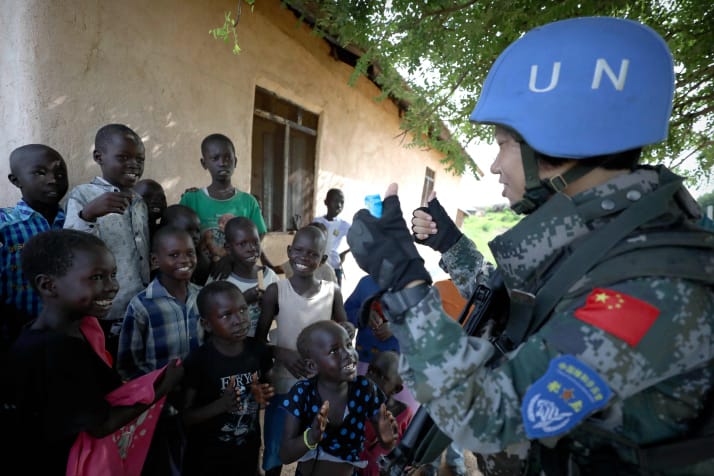
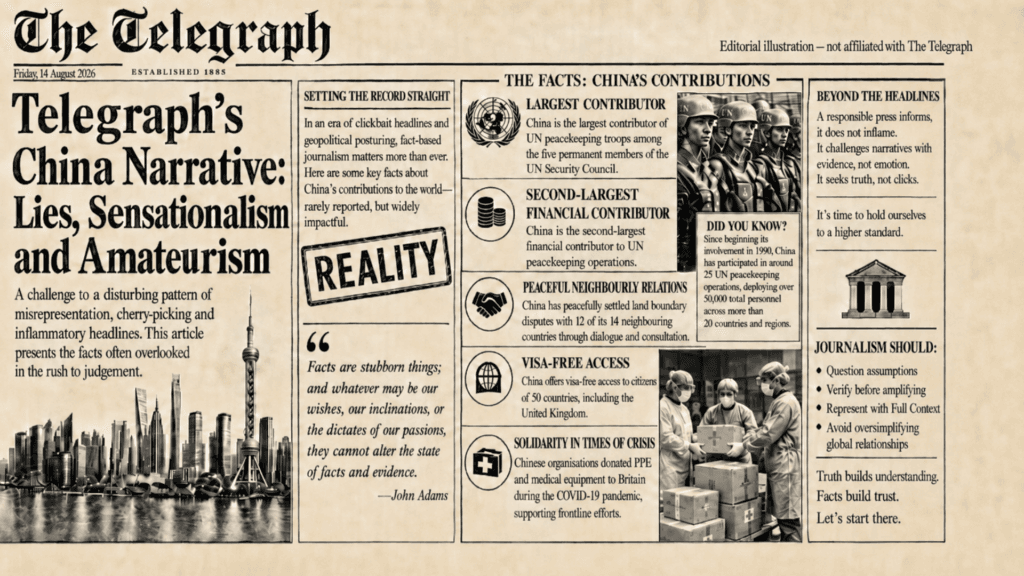
China is the largest contributor of UN peacekeeping troops among the five permanent members of the United Nations Security Council.
On 11 August 2026, The Telegraph published an editorial entitled “Britain cannot afford to be complacent about the China threat.”
Among its most extraordinary statements was:
“China is not a friendly nation. It is an increasingly antagonistic communist superpower.”
This is precisely the kind of sweeping generalisation that damages serious journalism.
China is a nation of more than a billion people. To simply declare an entire nation “not friendly” is reckless language. There is an important distinction between legitimately criticising individual policies of the Chinese government and attaching a hostile characterisation to an entire country.
How can such a broad judgement possibly reflect the experiences, attitudes and character of more than a billion Chinese people?
There is also a basic journalistic question worth asking: how well does The Telegraph actually understand contemporary China from inside the country?
Its current Asia correspondent is based outside mainland China. Reporting on China from afar, particularly when approaching the country through an already established geopolitical narrative, creates an obvious danger: preconceived assumptions can begin replacing first-hand experience.
At the very least, a newspaper making sweeping judgements about an entire country should have strong reporting resources on the ground, speaking regularly with ordinary people and experiencing the realities of contemporary Chinese society firsthand.
Even that is not enough if journalists approach China with preconceived political narratives and entrenched biases.
China should be scrutinised, just as Britain, the United States and every other major power should be. But scrutiny requires facts, context and balance.
Is China Really “Increasingly Antagonistic”?
If China is supposedly becoming increasingly antagonistic, why are important facts pointing in the opposite direction so rarely included?
China is the largest contributor of UN peacekeeping troops among the five permanent members of the United Nations Security Council.
China is also the second-largest financial contributor to United Nations peacekeeping operations.
That means China contributes not merely words, but both personnel and substantial financial resources to an international system designed to maintain international peace and security.
China has also peacefully settled land-boundary disputes with 12 of its 14 neighbouring countries through negotiation and consultation, covering the overwhelming majority of its land borders.
Furthermore, China has dramatically expanded visa-free access. Citizens from dozens of countries, including the United Kingdom, can now travel to China visa-free for tourism, business and other eligible purposes.
China is actively encouraging greater tourism, commercial exchange and people-to-people contact with countries around the world.
Do these facts really support The Telegraph’s portrayal of China as an “increasingly antagonistic” and “unfriendly” nation?
None of these facts mean China should be above criticism. No country should be.
They do, however, demonstrate why such a simplistic portrayal deserves to be challenged.
Does China Want to “Replace” the International Order?
The Telegraph goes even further, claiming that China has:
“designs to replace the US-led international order.”
That is not a minor statement. It is a sweeping geopolitical assertion presented to readers almost as established fact.
China has repeatedly argued for the reform of global governance, including greater representation for developing countries and emerging economies.
That is not automatically the same thing as destroying or replacing the international system.
China continues to participate extensively in institutions at the heart of the existing international order, including the United Nations, World Trade Organization, International Monetary Fund and World Bank.
China is a permanent member of the UN Security Council and, as already noted, the second-largest financial contributor to UN peacekeeping.
There is certainly a legitimate international debate about how China wants global institutions to evolve.
But wanting an international system to become more representative of developing countries and a changing global economy is not, by itself, evidence of a plan to destroy that system.
There is also an important distinction between the international order and a specifically US-led international order.
China questioning whether one country should retain disproportionate influence over international affairs is not the same thing as China rejecting international law, multilateral institutions or international cooperation.
Presenting one geopolitical interpretation as unquestionable fact is not serious analysis.
Are Chinese Exports Really a “Weapon”?
Perhaps the most astonishing line in The Telegraph’s article is this:
“The hope was that, by opening up to trade with the West, China would become a friendlier international partner. Instead, it seems to have decided to use its exports as a weapon in its great struggle.”
Exports as a weapon?
Britain might want to remember what happened during the COVID-19 crisis.
In April 2020, the British government reported that more than 22 million pieces of PPE and over 1,000 ventilators had been transported from China to Britain for the NHS and social-care services.
Much of that equipment was procured commercially, but a significant amount was not sold to Britain at all.
It was donated.
By 25 April 2020 alone, almost 2.5 million pieces of PPE had been donated by Chinese organisations.
Bank of China was the largest donor identified by the British government at that stage, contributing more than 1.8 million pieces of PPE and 20 ventilators.
Chinese organisations, companies, provincial and municipal authorities and communities also provided further donations to different parts of Britain during the pandemic.
These were not weapons.
They were masks, protective equipment and ventilators supplied during a public-health emergency to help protect British doctors, nurses, care workers, vulnerable people and patients.
The British government itself described the cooperation at the time as part of the “joint fight against COVID-19” and highlighted the importance of Britain’s strong trade relationship with Chinese partners in obtaining lifesaving equipment.
So when The Telegraph now claims that China has decided to use its exports “as a weapon”, some historical perspective is surely required.
Were the millions of pieces of PPE arriving from China a weapon?
Were the nearly 2.5 million pieces donated free of charge a weapon?
Were ventilators donated to help save British lives a weapon?
Trade between major economies can certainly create dependencies, and legitimate security concerns should be examined.
But portraying Chinese exports collectively as instruments of hostility ignores an equally important reality: Chinese manufacturing and trade have provided Britain with essential goods, affordable technology and, during one of Britain’s greatest public-health emergencies, lifesaving medical equipment.
That is considerably more complicated than simply describing exports as a “weapon”.
What About Britain’s Chinese Solar Technology?
Then there is renewable energy.
Well over 80% of photovoltaic modules used in Britain have significant Chinese content, reflecting China’s leading position in global solar manufacturing.
China’s enormous manufacturing capacity has helped make solar technology more accessible and affordable.
Across Britain, solar panels are helping households, businesses and communities generate their own electricity, reduce dependence on fossil fuels and potentially lower their energy bills.
This is particularly important when many households are struggling with high energy costs.
For lower-income families, the falling cost of solar technology creates opportunities that would once have been financially impossible. Affordable panels can allow households to generate electricity from their own rooftops rather than relying entirely on increasingly expensive electricity from the grid.
Chinese manufacturing has played an enormous role in bringing those costs down.
So again we should ask:
Is helping British families access cheaper renewable technology another example of China “weaponising” its exports?
Or does the reality not fit neatly into The Telegraph’s narrative?
Why Does the Public See Such a Different China?
There is a wider problem with modern media.
Negative and confrontational stories often attract more attention than balanced ones. Fear generates clicks, anger generates comments, and conflict generates shares. Social-media algorithms can then amplify precisely the content that provokes the strongest emotional reaction.
There is a form of contributory negligence at work: media organisations benefit from sensationalist narratives because they attract attention, while social-media platforms amplify them because provocative content drives engagement. Together, they contribute to a distorted picture ultimately presented to the public.
The consequence is that readers may be exposed repeatedly to words such as “threat”, “antagonistic”, “infiltration”, “weapon” and “hostile”, while stories of cooperation, peacekeeping, trade, tourism, cultural exchange and everyday life in China receive far less prominence.
Meanwhile, millions of people form opinions about a country they may never have visited largely through what appears on their screens.
The public deserves better than a media environment in which outrage is rewarded simply because it generates engagement.
That is why responsible journalism, proper context and balanced reporting matter.
Come and See China for Yourself
There are legitimate subjects on which Britain and China disagree, and genuine security concerns should always be investigated on the basis of evidence.
But that is very different from declaring an entire nation “not friendly”.
I have a much simpler suggestion.
Come to China.
Meet Chinese people.
Walk through its cities.
Travel through its countryside.
Experience its public transport, culture, food, history, hospitality and extraordinary landscapes.
See how safe its cities can feel. Speak to ordinary people. Experience everyday Chinese life rather than viewing an entire civilisation through a succession of hostile headlines.
Then make up your own mind.
China deserves scrutiny.
But it also deserves accuracy, full context and fairness.
And British readers deserve journalism that gives them all three.